Generation 0
Five cells inside 3 x 3
Start by checking how little information the seed gives you. The useful surprise is that this tiny shape is already enough to create a long, messy history.
Methuselahs
A five-cell seed that takes over one thousand generations to stabilize.
The R-pentomino is the classic proof that small initial conditions can create unexpectedly long histories: five cells in a 3 x 3 box eventually stabilize with 116 cells and six escaping gliders.
R-pentomino begins with five live cells inside a 3 x 3 box, stays active for 1,103 generations, and stabilizes into 116 live cells including 6 escaping gliders. Run this page when you want the exact seed and its live evolution.

R-pentomino run guide
If you came here for the R-pentomino seed, its 1,103-generation lifespan, or final population 116, watch the first few ticks, then let the long transient run on a wide board.
Generation 0
Start by checking how little information the seed gives you. The useful surprise is that this tiny shape is already enough to create a long, messy history.
Early ticks
Step slowly through the first few generations. The pattern quickly stops looking like a pentomino and starts producing local debris that is hard to predict by eye.
Long middle
A cramped board gives the wrong lesson because boundary effects clip the reaction. The point is to let the debris and gliders travel without hitting the edge.
Final ash
After 1,103 generations, the standard evolution settles into 116 live cells including six gliders. That final census is why this page calls out the number directly.
These are the checkpoints most readers look for when they compare a small methuselah seed with its final population.
Generation 0
The start has only five live cells inside a 3 x 3 box. This is the canonical R-pentomino seed used for the run.
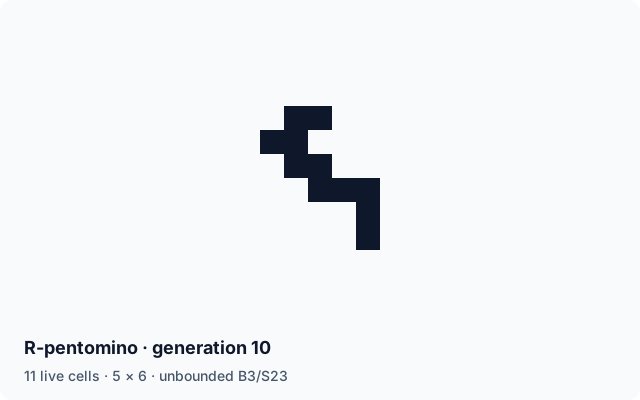
Generation 10
The pattern is already no longer visually obvious. Single-step mode helps show how births and deaths stop matching the original pentomino.
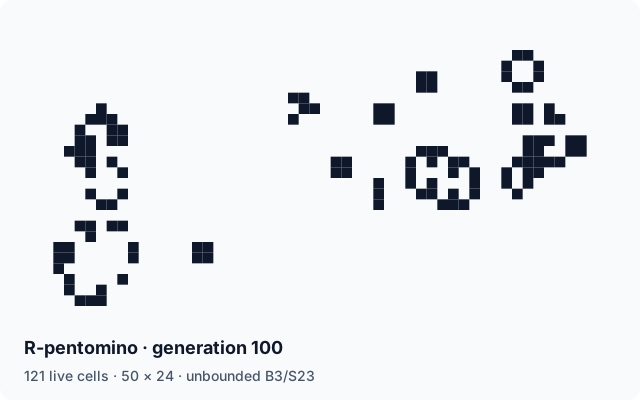
Generation 100
The reaction has spread far enough that a small board becomes misleading. Use the embedded lab view before judging the final result.
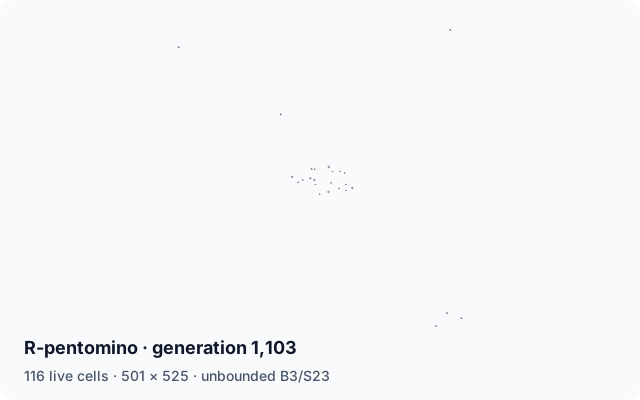
Generation 1,103
The standard census is 116 live cells, including 6 escaping gliders, after the long-lived transient finishes.
Exact generation snapshots
Generation 1,103 has 116 cells on the unbounded plane. Escaping gliders make the footprint much wider than a teaching board.
These images are computed on an unbounded B3/S23 plane. Each frame is fitted to its own live-cell bounding box; compare the labels rather than the apparent scale.
Use it to teach emergent complexity from very small seeds.
Explore the complete 3×3 seed experiment
Open the pattern in the lab, reduce the speed, and use single-step mode when a phase change is hard to see. The green preview marks births in the next generation; red outlines mark live cells that will die.
Fast answers
Yes. The R-pentomino has five live cells inside a 3 x 3 bounding box and is the classic compact methuselah example.
The standard R-pentomino evolution stabilizes with 116 live cells, including 6 escaping gliders, after 1,103 generations.
It starts very small but stays active for an unusually long time before settling into final ash and escaping gliders.
Use a roomy board so debris and gliders are not clipped by the boundary. The live lab starts on a wide board for that reason.