What to watch
- Step once to see a 90-degree phase change.
- Step twice and it returns to the initial state.
- It is the most common oscillator in random soup ash.
Oscillators
The smallest oscillator, flipping between vertical and horizontal lines.
The blinker makes the Life rule legible in two steps: the endpoints die, and the two side births create the perpendicular phase.
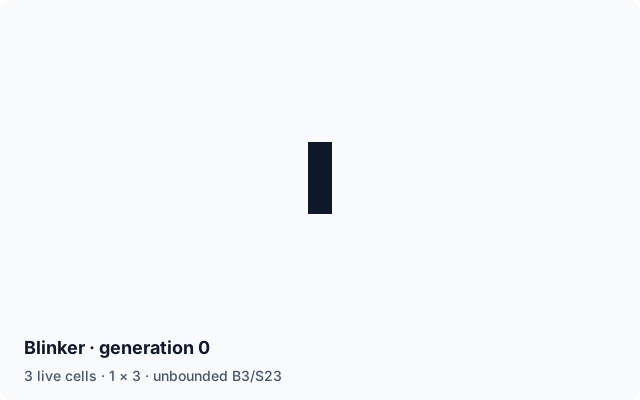
Exact generation snapshots
The three-cell line returns after two generations.
These images are computed on an unbounded B3/S23 plane. Each frame is fitted to its own live-cell bounding box; compare the labels rather than the apparent scale.

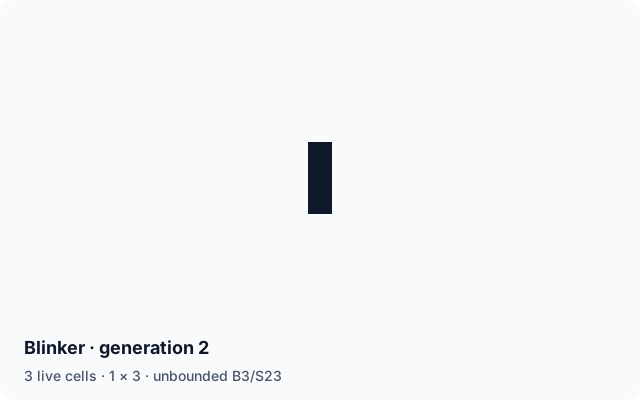
Use it as the first periodic example after still lifes.
Compare this pattern with its family
Open the pattern in the lab, reduce the speed, and use single-step mode when a phase change is hard to see. The green preview marks births in the next generation; red outlines mark live cells that will die.
Next experiments
Move between similar structures to see which facts change: box size, lifespan, extinction, motion, and final ash.
A period-2 oscillator made from two offset rows of three cells.
Two blocks that repeatedly switch their touching corner cells.
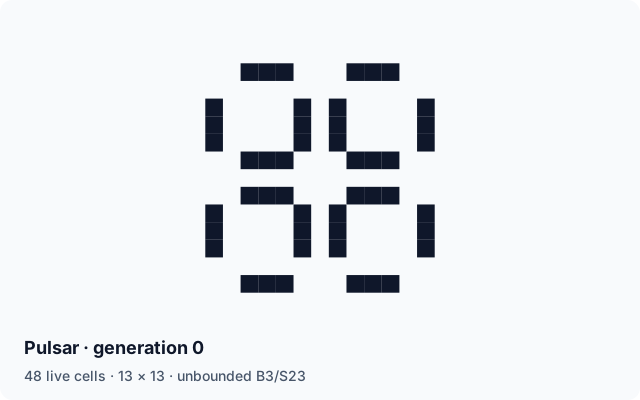
A large period-3 oscillator with strong fourfold symmetry.
A slim oscillator with a much longer cycle than its size suggests.