What to watch
- It takes 15 steps to return to its original phase.
- Most phases remain narrow and readable.
- The two notches control the long cycle.
Oscillators
A slim oscillator with a much longer cycle than its size suggests.
The pentadecathlon is a compact way to show that period length can grow faster than visual complexity.
The pentadecathlon is a compact oscillator that returns to its starting phase after 15 generations. It is useful after the blinker and pulsar because the cycle is longer while the shape remains easy to follow.
Use it to introduce period notation beyond p2 and p3.
Compare this pattern with its family
Open the pattern in the lab, reduce the speed, and use single-step mode when a phase change is hard to see. The green preview marks births in the next generation; red outlines mark live cells that will die.
Fast answers
The pentadecathlon has period 15. Run 15 generations and the starting phase should return in the same place.
The name points to its 15-generation cycle. On this site, the useful exercise is to compare that cycle with period-2 and period-3 oscillators.
Compare it with the blinker for period 2 and the pulsar for period 3 before moving to period-30 shuttle and gun patterns.
Next experiments
Move between similar structures to see which facts change: box size, lifespan, extinction, motion, and final ash.
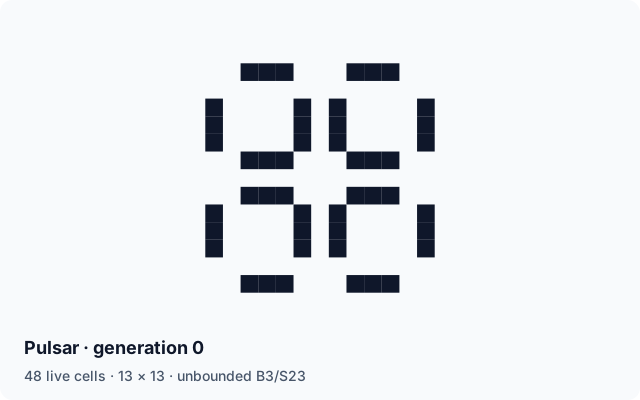
A large period-3 oscillator with strong fourfold symmetry.

The smallest oscillator, flipping between vertical and horizontal lines.
A period-30 oscillator closely tied to early glider-gun history.
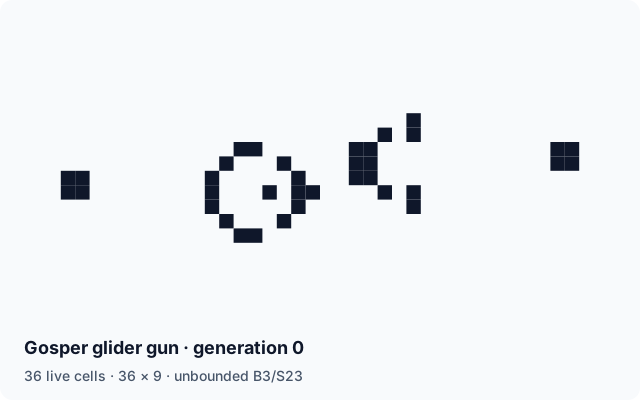
The first known finite pattern with unbounded growth.